
Ornamental vs. Minimalist Railings: Which Suits Your Home?
Ornamental railings suit houses that already have traditional detail, like Colonials, Tudors, and Victorians. Minimalist railings suit modern homes, renovated interiors, and anywhere you want to keep a view open. Most Connecticut homes end up between these two wrought iron railing styles, with plain pickets and one decorative detail.
Which one fits yours comes down to the architecture, where the railing goes, and how much upkeep you want to take on.
We build custom railings in both styles at our shop on Albany Avenue in West Hartford. Here is how we walk customers through the choice.
Two wrought iron railing styles, one material
First, a quick point about the word "iron." Most railings people call wrought iron today are fabricated from steel and finished black. True wrought iron is an older material that is rarely used now.
That matters here because ornamental and minimalist railings come out of the same steel bar, the same welder, and the same finish line. What changes is how much the metal is asked to do visually.
What makes a railing ornamental
Ornamental railings, sometimes called decorative metal railings, use the metal as decoration as well as support. Typical details include:
Scrolls, either as full panels or as single accents
Twisted pickets and basket twists (pickets are also called balusters)
Collars, the small rings that sit partway up a picket
A cap rail with a shaped profile
A lamb's tongue, the curled end where a handrail finishes
Ornamental does not have to mean busy. Plenty of wrought iron railing designs use plain pickets with one collar on each, and they still count as ornamental. So does a geometric pattern with no curves at all.
What makes a railing minimalist
A minimalist railing, which most people search for as a modern wrought iron railing, strips the design down to what holds you up. Square or flat bar. Straight vertical pickets or a few horizontal bars. Crisp corners, no added detail.
Cable and stainless steel systems are modern railings too, popular where the goal is an open view.
With so little to look at, proportion carries the whole design. Bar thickness, picket spacing, and the way the rail meets the post all have to be right.
Ornamental vs. minimalist at a glance
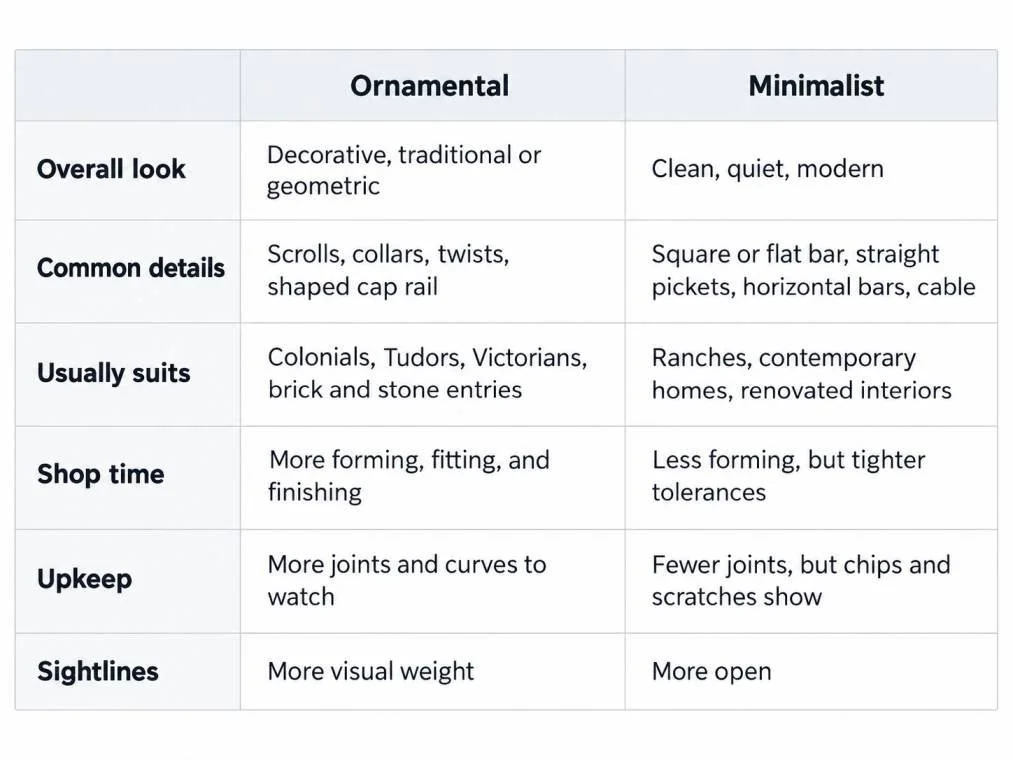
Which railing style fits your house
Start with the house, then your taste. A railing that matches the architecture tends to look like it was always there.
Colonials, Tudors, and Victorians
These houses already have detail: paneled doors, shutters, brick or stone steps, lantern style lights. An ornamental railing picks up on that. On a Colonial it usually means restraint, such as straight pickets with a collar or a single scroll at the newel post. Tudors and Victorians can carry heavier work.
Capes and ranches
These are simpler houses with low entries. A plain picket railing or a single handrail usually looks right. Heavy scrollwork on a three step ranch entry tends to look like it came from a different house.
Contemporary homes and opened up interiors
If walls have come down and the stair now sits in the middle of the living space, a minimalist railing keeps the room open. Flat bar, thin vertical pickets, or cable all work. A black metal stair railing with plain vertical pickets is the request we hear most for interiors.
Where the railing goes matters too
Front steps and porch railings are the first thing people see, so curb appeal and matching the architecture count most there. It is why most metal railings in West Hartford stay simple and black out front.
Inside, you see the railing up close every day, so an interior staircase railing gives you more freedom to go modern, even in an older home.
Out back on a deck or balcony, most people care more about the view than the detail, which is where cable and aluminum come up.
What each style costs, and why
We cannot give a fair price without measuring, but we can tell you what drives the number.
Ornamental work takes more hours. Every scroll has to be formed, fitted, welded, and ground clean. A panel full of scrolls has several times the welds of a plain picket panel. Finishing takes longer too, since there is more surface and more tight corners to coat.
Minimalist is not automatically the cheap option. A plain black steel picket railing is usually the least expensive custom railing to build. But a modern design in stainless steel or cable often costs more than a modest ornamental one, because the material costs more and there is nowhere to hide a weld that is slightly off.
In many jobs, style is not even the biggest factor. Length, the number of posts, curves in the staircase, and whether the railing mounts into wood, concrete, or masonry can move the price more.
Upkeep in Connecticut weather
Outdoor steel in New England lives through road salt, wet springs, and months of freeze and thaw. Whichever style you choose, the finish is doing the hard work. For exterior railings we recommend powder coating, often over galvanizing. Black is the usual color, with bronze, dark gray, and hand applied patinas available for a warmer look.
Style changes where problems start. Rust usually begins at joints and in spots where water sits. Ornamental railings have more of both: the inside of a scroll, the top of a collar, the point where two curves touch. They also take longer to clean and touch up.
Minimalist railings have fewer places for water to hide. The tradeoff is that a chip from a snow shovel on a flat black bar is easy to spot. Indoors, horizontal bars collect dust and stainless steel shows fingerprints.
No finish is maintenance free. Cleaning your wrought iron railing each spring and touching up any spot where the coating is damaged goes a long way.
Safety and code apply to both
Style does not change the rules. The residential code Connecticut follows sets a minimum height for guards and limits openings so that a 4 inch ball cannot pass through. That covers the gaps inside a scroll pattern too, so ornamental designs have to be laid out with it in mind.
If you have small children, think carefully about a horizontal railing. The bars can work like a ladder. Vertical pickets are harder to climb.
If anyone in the house is unsteady on stairs, the shape of the handrail matters more than anything decorative. It should be easy to wrap a hand around.
Your town's building department has the final say on what is required, and some Connecticut towns ask for a permit.
The middle ground most people end up choosing
You do not have to pick one of the two wrought iron railing styles outright. Very few of our customers want a railing covered in scrollwork. Very few want one so plain it looks like it belongs on a loading dock. Most land in between.
That usually means straight pickets with one considered detail. A collar on every picket. A scroll at the starting post and nothing else. A shaped cap rail over plain square bar. A lamb's tongue where the handrail ends.
A railing like this costs less than a fully ornamental one and is easier to keep up, yet it still looks made for the house. It is also easy to live with if you sell later, since it does not push a buyer toward one taste.
This is where custom metal railings earn their keep. You are not choosing from a catalog page, so the detail can go up or down until it looks right on your steps.
Five questions that usually settle it
What does the house already have? Look at the front door, the light fixtures, and any existing ironwork, then match those.
Where will you see the railing from? The street, the sofa, and the kitchen window each call for something different.
Who uses it? Kids, older parents, and guests carrying things all change the answer.
How much upkeep will you really do?
Are you staying ten years or two?
If your answers point in different directions, the middle ground is probably right for you.
How we help you choose
Send us a few photos of the steps or staircase. We look at them before we visit so we arrive with ideas. Then we come out, take field measurements, and document the space with photos and video. Within 2 to 3 days you get a written proposal with images, so you can see the design before anything is cut.
If you would rather see the options first, stop by the shop at 2575 Albany Avenue. We keep finish samples and sample work there, and comparing a collar to a plain picket in person takes about a minute.
We work with homeowners, designers, and contractors in West Hartford, Farmington, Avon, Simsbury, and nearby Hartford County towns, and we take on projects across Connecticut.
Frequently asked questions
What is the difference between ornamental and minimalist railings?
An ornamental railing uses decorative metalwork such as scrolls, collars, twisted pickets, or a shaped top rail. A minimalist railing uses plain square or flat bar, straight lines, and no added detail. Both can be built from the same steel with the same finish, and both are equally strong. Only the design differs.
Are ornamental railings more expensive than minimalist railings?
Usually, when both are built from steel. Ornamental details add forming, welding, and finishing time, while a plain steel picket railing is typically the least expensive custom option. Minimalist designs in stainless steel or cable can cost more than a modest ornamental railing because the material itself costs more.
Will a modern railing look out of place on an older Connecticut home?
On the front of a Colonial or Tudor, a very modern railing can look out of step with the house. Inside, it often works well, especially after a renovation. A simple picket railing with one traditional detail is a safe choice that suits most older homes.
Which railing style holds up better outdoors in Connecticut?
The finish matters more than the style. A powder coated railing, ideally over galvanizing, resists salt and moisture well in either design. Ornamental railings have more joints and curves where water can sit, so they deserve a closer look each spring. Neither style is maintenance free.
Can I mix wrought iron railing styles in one railing?
Yes. Many homeowners combine ornamental and minimalist details. Common combinations are straight pickets with a collar on each, a single scroll at the starting post, or a shaped cap rail over a plain bar. Because each railing is custom built, the amount of detail can be adjusted to suit the house.
So, which one suits your home?
Both wrought iron railing styles have their place. If your house has traditional detail and the railing sits out front, lean ornamental and keep it restrained. If the space is modern, or you want to keep a room or a view open, lean minimalist. If you are somewhere in between, plain pickets with one good detail is rarely the wrong call.
The easiest way to know is to see it drawn for your own steps. Send us a few photos, or come by the shop in West Hartford and we will go through it with you.
